Showing posts with label sustainability. Show all posts

Thursday, January 14, 2010

What's for Lunch?

I spent some 15+ years as a desk jockey. Most days were packed full of code and report writing, meeting and managing, pointless PowerPointing, and plenty of office politicking. Some people thrive on that stuff, finding it meaningful and thrilling; to me, it was an energy drain.

So with this jaded outlook, you'd think that lunchtime would be the best part of my workday, right? Well, yes and no. Yes for the days I got to ride my bike. Oh glorious lunch rides! But definitely "No" for the days when I joined ranks with the other thousand automatons making the daily drive to restaurant row. Don't get me wrong, I liked my coworkers and their company. It was the food that was the problem. Chili's, Chevy's, Wendy's, Jack in the Box.... there's really no difference. And more and more, what you get at those establishments can hardly be called food. GMO corn with bacteria genes inserted into its DNA? Freaky!

Some people microwaved frozen lunches instead. Have you seen the ingredient lists on those things?? Should you really need a PhD in Chemistry to understand what you're eating? Some days I'd bring a brown-bag lunch my sweetie made me that morning. PB&J ...again. I'd eagerly anticipate... would it be strawberry or marmalade today? Sigh.

Fast-forward to 2010. I don't work in an office anymore, and I don't eat at those kinds of "restaurants" either. But lunch is still a dilemma sometimes. Strawberry or marmalade? Now it's up to me to decide.

So today I finally tried Organic Living Santa Barbara. I've been hearing the buzz for months... wonderful variety of lunch entrees, made fresh daily from locally-sourced organic ingredients, delivered right to your home or office. They'll even accommodate your vegan, vegetarian, or meat-eater preferences.

Here's what I got today (click the picture to read the label, and you don't need a PhD in Chemistry):


It was delicious! I actually ordered two meals, which was enough for dinner also. Such a tasty and sensible way to solve the lunchtime dilemma. And way more healthful and environmentally responsible than eating at those chain restaurants.

As an aside, today I rode my fastest time up Old San Marcos in at least nine months. Coincidence?? I don't think so.

Monday, November 02, 2009

Get Your Power On


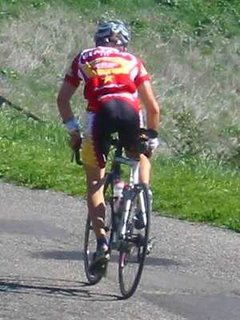
Doing just a little math, you can figure that eight riders like the ones above are generating a combined power of around 3 kW, give or take, during a one hour TTT. Cool. That would easily power your house for an hour.

So here's a thought... build up eight stationary trainers, hook them all to a DC generator with an DC-AC inverter, then plug it into your electrical service panel. Now invite that team over to your house for a TTT session on the trainers and, shazzam, free electricity!!

Well, almost free... they do need a salary I suppose. Also, they'll only ride for an hour before cracking and falling off their bikes. I guess you'll need to hire a few more teams, like maybe the entire field of the Tour de France, if you want to cover all your energy usage.

Or here's another thought... slap a few of these babies onto your roof:

They'll make power all day long and you won't even need to feed them. Sure, there will be some upfront cost, but thanks to generous state rebates (here in CA) and the forward-thinking policies of our country's CEO, you can expect to recoup your costs within 10-15 years, depending on the specifics of your situation. And if it wasn't compelling enough before, just a few weeks ago our Governator signed a bill requiring California's utilities to pay homeowners for any surplus power they generate. This is the wave of the future, for sure.

So let's bring this back around to cycling. I estimate that our photovoltaic system will generate about 20 kWh of energy a day, averaged over the year. How much is that? Well, it's roughly equivalent to the (mechanical) power I'd make doing 267 maximum-effort rides up Old San Marcos Rd., assuming I could capture it. [20 kWh / (.3 kW X .25 h)]

Full disclosure: My generous and forward-thinking parents offered to pay for our solar installation. Their offer is to each of my three siblings as well. Gina and I plan to gladly accept that gift, although we like to think we would have taken this step anyway.

Monday, June 29, 2009

From Dirt to Dinner

My "if-money-were-no-object" fantasy is to develop and manage a small farm just outside of town along with a small co-located restaurant where nearly all the food is grown or raised on the property. Naturally the menu would be seasonal, perhaps even changing daily depending on the vagaries of farming successes and failures. This fantasy would be the ultimate in eating local and farm-fresh-to-table. For those customers who want a stronger connection with their food, I'd encourage them to tour the farm before or after they eat. Maybe we'd also have a small farm stand to sell any extra produce.

This idea is half-baked at best, but my gut tells me it's doable, although perhaps not particularly profitable. I'd guess 10-20 acres could support a 5-10 table restaurant. That's asking the land to be a lot more productive than what we see currently in our industrial-farming paradigm, where it takes about 1.5+ acres to feed each man, woman, and child in the US. That is a real problem, by the way, because it's almost precisely the amount of arable land available per capita. As the graph below shows, the trends are troubling...


...because our population is growing and our arable land is disappearing (to erosion, depletion, and urban sprawl). What happens when we cross over? Do we become a net importer of food, dependent on foreign countries for our nutrition? Even now, with most of our food grown in the US, the average meal travels 1,500 miles to reach your plate. That's just nuts. And don't even get me started on the environmental damage done by the industrial farming mega businesses. Here's an industrial dairy's manure lagoon to whet your appetite:


Yum... I bet that's some tasty groundwater coming up from those wells in nearby towns. The really crazy thing is that the manure should be a valuable asset to the local agriculture, if it just weren't so concentrated in the feed lots and not full of pharmaceuticals and hormones. For a better way, see Polyface Farms, the place made famous in the book "The Omnivore's Dilemma".

What can you do? Lots of things. Buy local, eat lower on the food chain, grow some of your own fruits and vegetables. For those blog readers here in Santa Barbara County, consider signing the online petition to urge our leaders to preserve Goleta farmland.

...

But anyway... all that stuff above is not what I really intended to write about. All I really wanted to post was the two pictures below.

First picture shows a portion of what I harvested from my backyard on Saturday. The potatoes were mostly a failure because all I got from about 40 sq. feet was a single brown bag full. Most of the plants died from pests or disease. I think next time I'll try to grow them in containers. But everything else in the picture has been wildly successful. We have enough carrots and garlic to last for a year. In fact, I've been giving away most of the garlic. The onions have done well as have the squash. Rosemary is always around.


...and so we combined all that and tossed with some olive oil and roasted it for about an hour. Paired with herb roasted chicken and a mellow merlot, and this was dinner in our makeshift kitchen on our cheapo Corelle plates:

Wednesday, March 25, 2009

Alice Waters Rocks


(If the video doesn't work for you, try here instead.)

Monday, August 18, 2008

Western North Carolina Farmers Market

We like to check out Farmers' Markets in places we visit. Yesterday we went to the biggest one I've ever seen, the Western North Carolina Farmers Market in Asheville, NC. It's open for business 7 days a week, and it's probably where most families and restaurants around here get their produce. These farmers (and consumers) don't focus so much on organic methods, but at least they're selling and eating local. 'natch, I took some pics...


Tuesday, April 22, 2008

Farming in the Suburbs

This is the wave of the future...

The way we Americans eat is not sustainable. Our food travels over 1,000 miles on average between the field and the table. In the current industrial-farming paradigm, it takes about 1.5 acres of agricultural land to support each man, woman, and child in the US. The problem is, we are losing agricultural land at too rapid a rate due to urban sprawl and soil erosion and depletion. We are near the cross-over point. [A prediction: in a few hundred years, historians will be astounded at this generation's stupidity in destroying the land that sustains life ...just you wait and see!]

So yeah, dig up your water-wasting, chemical-hungry lawn and plant some food. That's what I'm doing...

Sunday, October 28, 2007

The Meatrix


The Meatrix I


The Meatrix II


The Meatrix II 1/2


Seems to me that we're not really that far away from Soylent Green.

Think about it.